
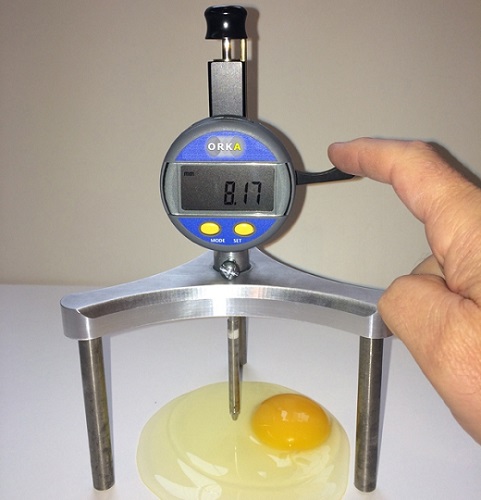
The Haugh unit (pronounced: “how”) is a widely recognized measure of an egg’s internal quality and freshness.
Introduced in 1937 by Raymond Haugh, this method quickly became a cornerstone of egg-quality assessment, alongside other key indicators such as eggshell thickness and eggshell strength.
The Haugh Unit test is performed by weighing an egg and then breaking it onto a flat surface (the breakout method). A micrometer is used to measure the height of the thick albumen (egg white). This measurement, when correlated with the egg’s weight, gives the Haugh Unit (HU) rating. Eggs with a higher Haugh Unit have thicker, firmer albumen, indicating fresher, higher-quality eggs.
The Haugh Unit is widely used by egg producers, packers, regulatory authorities, and research institutions to monitor and maintain consistent quality standards. It provides objective, quantifiable data that helps optimize production processes, storage conditions, and handling practices to preserve egg freshness.
It is important to note that while the Haugh Unit is an excellent indicator of egg freshness and internal quality, it does not provide information on the egg’s micronutrient or vitamin content. Other analytical methods are required to assess nutritional value.
Overall, the Haugh Unit remains a gold standard in the egg industry, helping ensure that eggs reaching consumers meet high standards of freshness, quality, and consistency.
The formula is as below:
HU = 100 * log10 (h – 1.7w0.37 + 7.6)
Where
- HU = Haugh unit
- h = observed height of the albumen in millimeters
- w = weight of egg in grams
The Haugh unit value ranges from 0 – 130 and it can be ranked as below:
- AA : 72 or more
- A : 71 – 60
- B : 59 – 31
- C : 30 or less
From our experience, a fresh egg is firm, and the whole egg appears almost as if it can “stand tall.” This is why the Haugh Unit testing method is so relevant. Simply measuring the albumen height alone can be misleading: a larger egg may naturally have a higher albumen height than a smaller egg, but this does not necessarily indicate better quality. The Haugh Unit accounts for egg size (measured by weight), allowing the relative albumen height to be calculated and compared accurately.
When calculating the Haugh Unit, the height of the thick albumen immediately surrounding the yolk should be measured.
It is important to note, however, that results can vary depending on which part of the albumen is measured. Care must be taken to measure the correct section of egg white to ensure accurate and consistent Haugh Unit calculations.
For your reference, below is the USDA‘s Terms descriptive of the egg white and its Haugh unit:
(a) Clear. A white that is free from discolorations or from any foreign bodies floating in it. (Prominent chalazas should not be confused with foreign bodies such as spots or blood clots.)
(b) Firm (AA quality). A white that is sufficiently thick or viscous to prevent the yolk outline from being more than slightly defined or indistinctly indicated when the egg is twirled. With respect to a broken-out egg, a firm white has a Haugh unit value of 72 or higher when measured at a temperature between 45 o and 60 oF.
(c) Reasonably firm (A quality). A white that is somewhat less thick or viscous than a firm white. A reasonably firm white permits the yolk to approach the shell more closely which results in a fairly well defined yolk outline when the egg is twirled. With respect to a broken-out egg, a reasonably firm white has a Haugh unit value of 60 up to, but not including, 72 when measured at a temperature between 45 o and 60 o F.
(d) Weak and watery (B quality). A white that is weak, thin, and generally lacking in viscosity. A weak and watery white permits the yolk to approach the shell closely, thus causing the yolk outline to appear plainly visible and dark when the egg is twirled. With respect to a broken-out egg, a weak and watery white has a Haugh unit value lower than 60 when measured at a temperature between 45 o and 60 o F.
*** Excerpt from United States Department of Agriculture (USDA)
United States Standards, Grades, and Weight Classes for Shell Eggs, AMS 56, Effective July 20, 2000
Before the Haugh Unit, the yolk index, which is defined as the ratio of yolk height over yolk diameter and provides indication on the freshness of the egg, was used from time to time, but was turned down after the introduction of the Haugh unit.
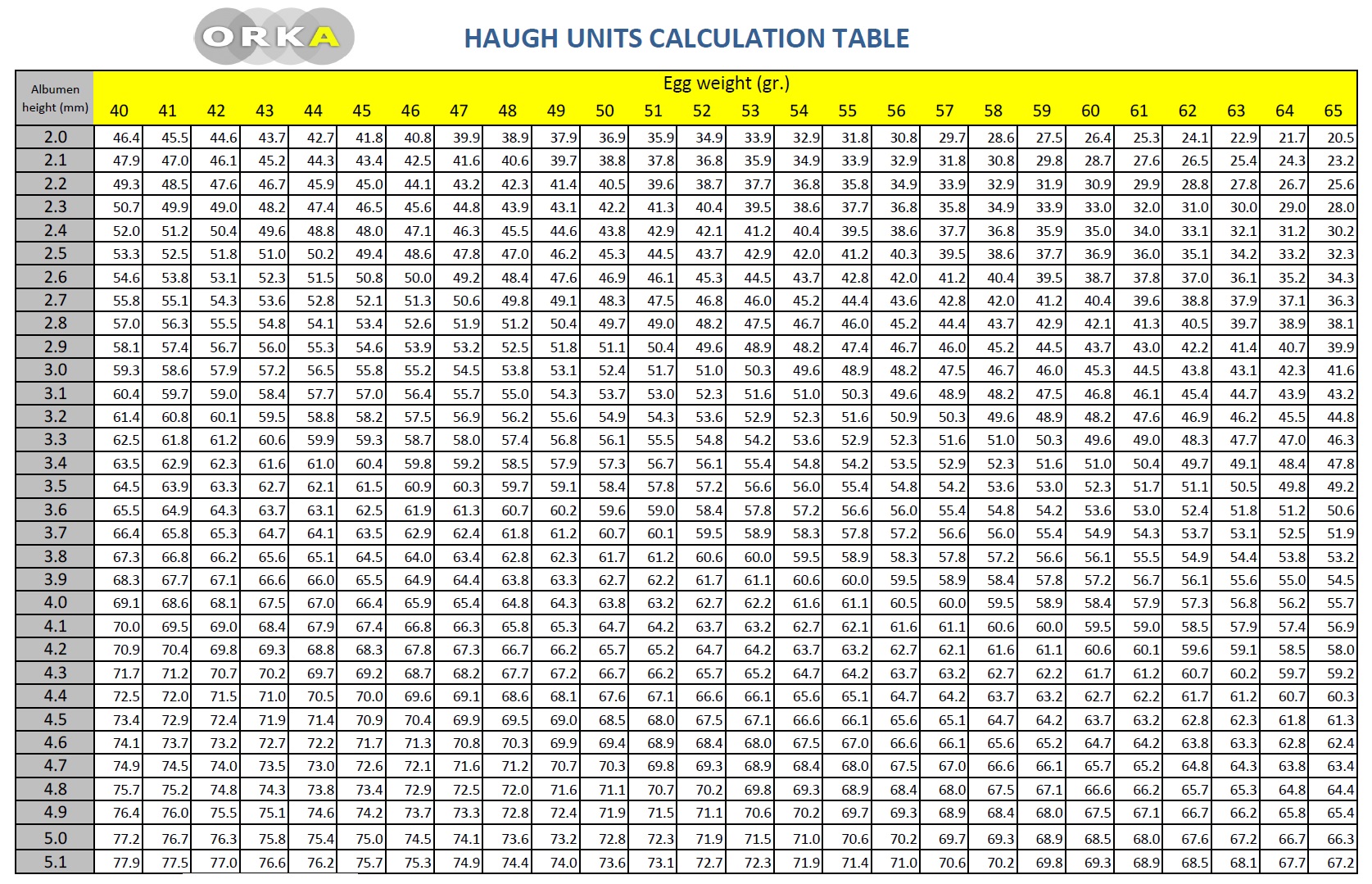
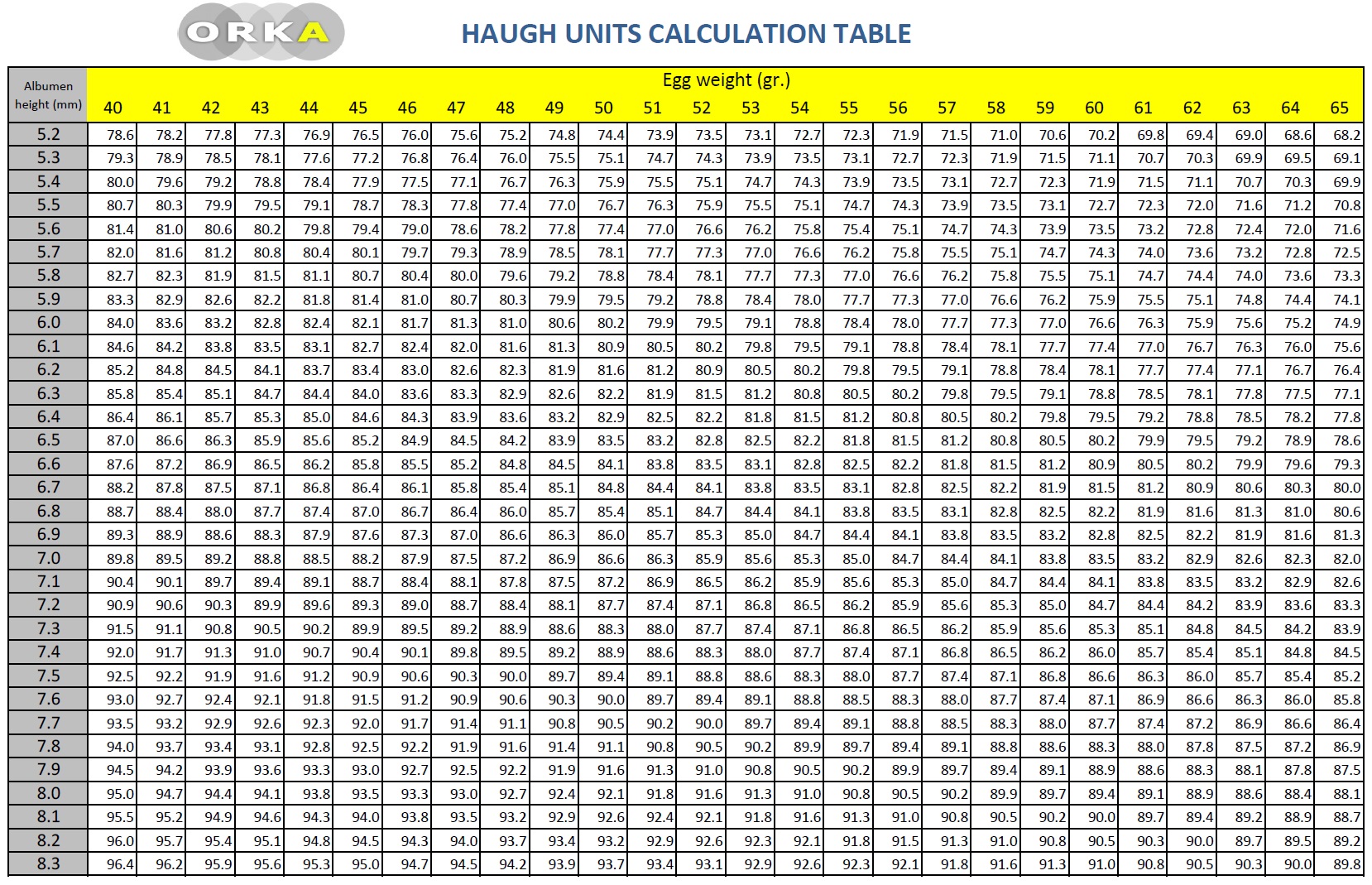
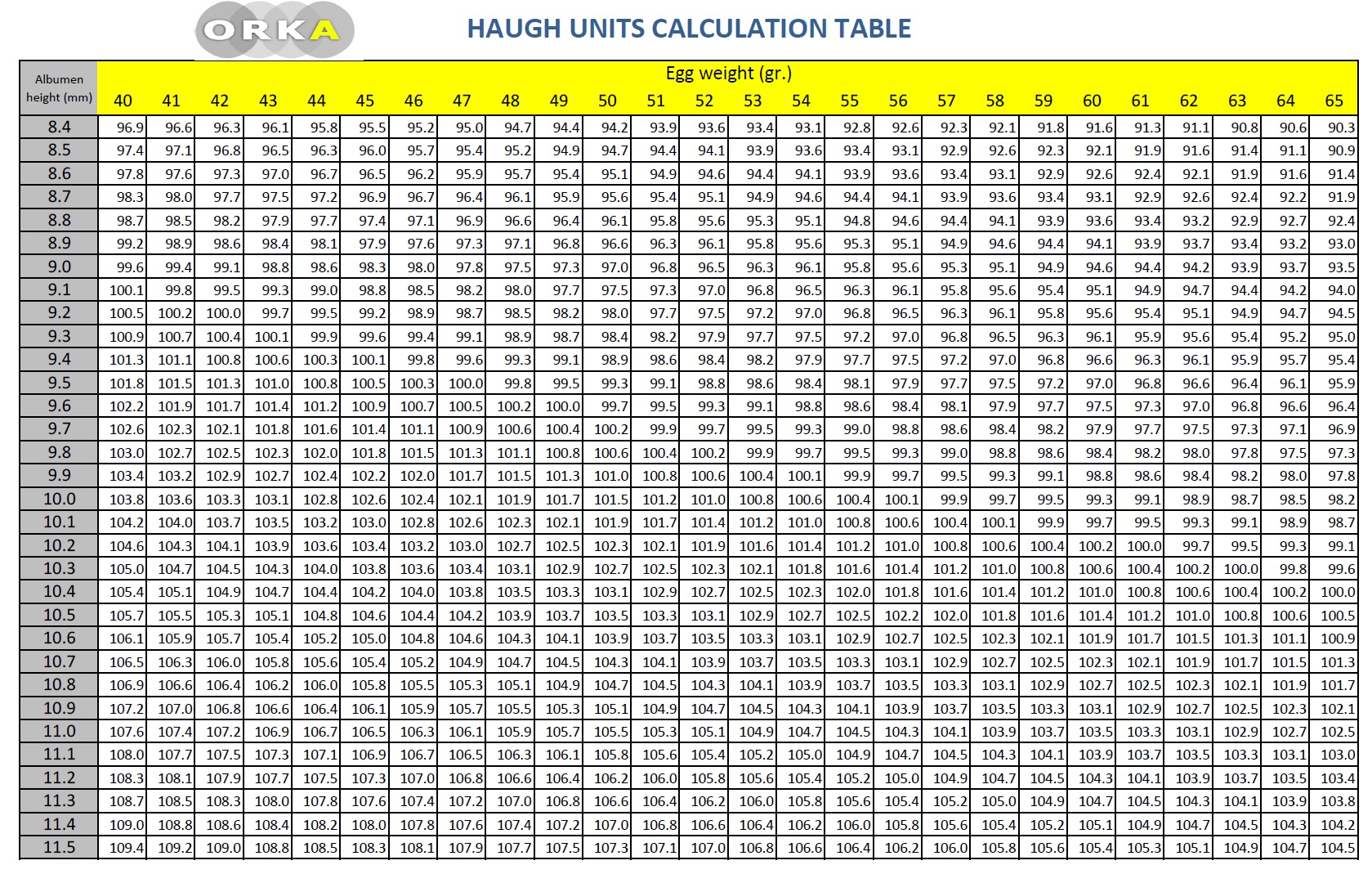
Below are Haugh Unit Calculation Tables (Haugh unit calculator) based on egg weight (gram) and albumen height (mm) for your reference.
For inquiries, please click here.